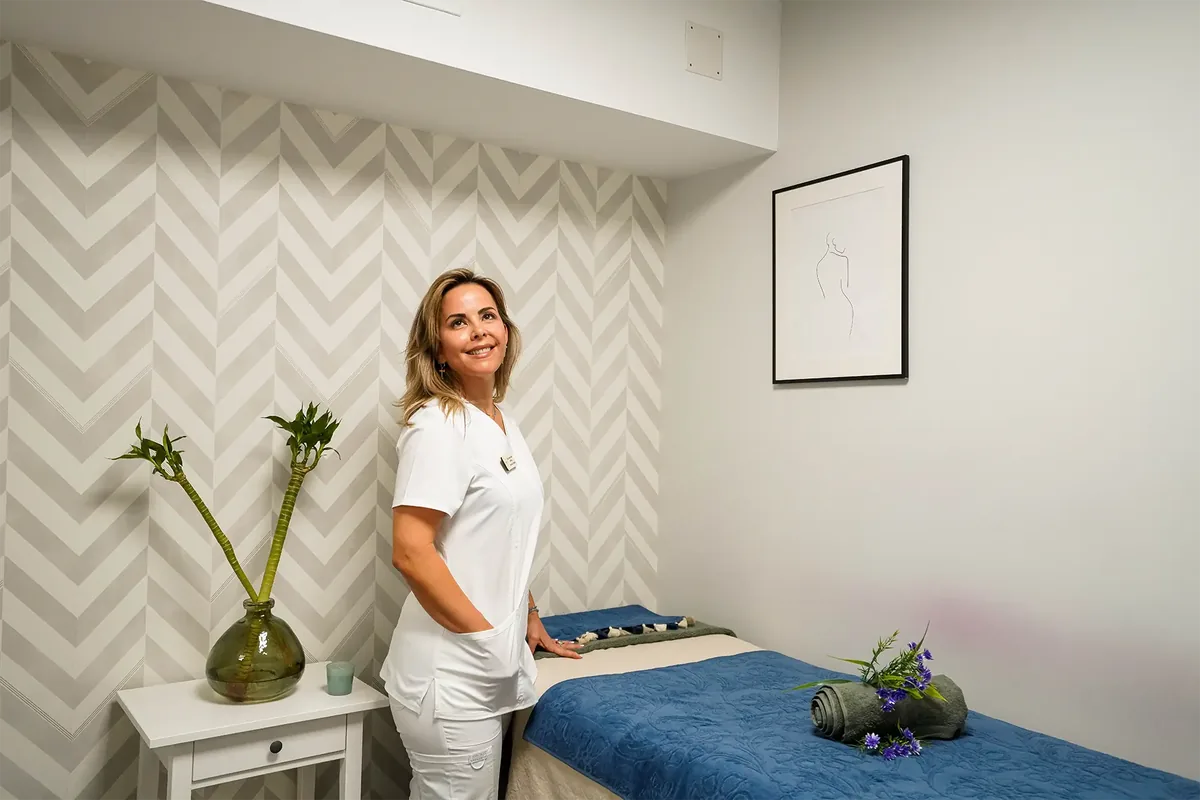
A first visit to an aesthetic medicine clinic often comes with questions: whether you will be treated that same day, how much it will cost, whether they will try to sell you something. This is what should happen at a well-run first assessment, how we approach it at Harmony by Agas and what is worth asking so that you leave with a clear picture.
Before you go
- Write down what concerns you and since when, in your own words.
- Bring a list of your medication, allergies and illnesses.
- Remember which aesthetic treatments you have had before, when and, if you know, with which product.
- If you have photos from a few years ago, they can help show what has changed.
What happens in the consultation
1. The conversation
First, the talk is about you: your health, your medication, your previous treatments and, above all, what you would like to change and why. Also about your expectations, because the same treatment can be a good idea for one person and a bad idea for another.
2. The examination
The doctor looks at the skin (quality, pigmentation, texture), volume, laxity and expression, at rest and in movement. Photographs are sometimes taken for the clinical record, always with your consent.
3. The diagnosis and the options
With all of this, the doctor explains what is happening and what options there are, including doing nothing. For each option you should know what to expect, how many sessions are needed, what the risks are and what recovery is like.
4. The plan and the quote
If you decide to go ahead, the plan and the quote are explained to you. You do not have to decide there and then.
5. Informed consent
Before any invasive treatment you will sign a consent form setting out the procedure, its risks and its alternatives, as required by Spain's Law 41/2002. Read it calmly and ask about anything you do not understand.
Will I be treated the same day?
It depends on the treatment and on each case. Some procedures can be done after the assessment if everything is clear; others need preparation, a test or simply time for you to think. If you have doubts, it is sensible to wait.
What should not happen
- Being offered a treatment before being asked about your health and medication.
- The price or a discount depending on deciding there and then.
- Not having the risks explained, or being told there are none.
- Being promised a specific result.
- Leaving without knowing which product or device would be used.
If any of this happens, it is sensible not to decide and, if you wish, to ask for another opinion.
If you have been treated at another clinic
Say so, even if it was years ago. With fillers in particular, it matters which product was used, when and in which area: it changes what can be done and when. If you still have the report, the card or the product label, bring them.
How we approach it at Harmony by Agas
Our principles are simple: diagnosis comes before treatment; the first consultation is a conversation, not a sales pitch; if something is not right for you, we tell you, and if we cannot help you, we refer you. The assessment is carried out by Dr Ava Guila Ardila Soto, medical director of Harmony by Agas (registration no. 282857315), at our clinics in Coslada and Torrelodones.
After the assessment
You leave with the diagnosis, the options and, if you ask for it, the quote. You can think it over, discuss it with whoever you like or ask for a second opinion. If you decide to go ahead, you are given an appointment for the treatment, you sign the consent form before starting and the review is planned. And if you have doubts at any point, you can ask before each step.
Questions worth asking
- What do you recommend and why, in my case?
- What alternatives are there, including doing nothing?
- What result is reasonable to expect and when is it assessed?
- What are the risks and what happens if a complication arises?
- Which product or device will be used?
- How many sessions do I need and how much does the whole plan cost?
- Is there a review afterwards?
If you want to know how to check the centre and the professional before you go, we explain it in how to choose an aesthetic medicine clinic in Madrid.
Frequently asked questions
Can I go just to find out more?
Yes. That is exactly what the assessment is for: knowing your options before deciding anything.
What should I bring?
Your list of medication and allergies and, if you have them, reports or details of previous treatments.
What if I decide to do nothing after the assessment?
That is as valid a decision as any other. The assessment is there so that you can decide with information, not to commit you.
How do I book the assessment?
By phone (+34 918 549 377), by WhatsApp (+34 649 674 923) or through the contact form.
This article is for general information. It does not replace an individual medical assessment.